
2. The power of superblocks
Superblocks reduce through traffic and create space for spending time, walking, cycling, greenery and neighbourhood life. Barcelona made the concept internationally known; Berlin developed Kiezblocks, a version strongly driven by local initiatives; Vienna has a high-quality implementation in Supergrätzl Favoriten and is now discussing cheaper “low-traffic neighbourhoods”. Studies prove the benefits to the residents. With a wide range of design options, superblocks are feasible in most neighbourhoods and across varying budgets.
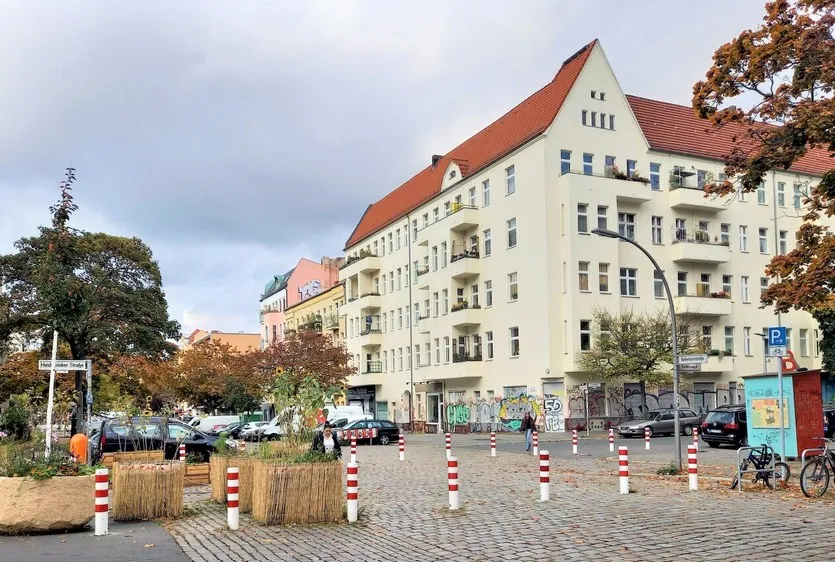
Bellermannkiezblock in Berlin-Mitte. Photo: BA SGA Mitte, L. Fritsche.
What changes
A superblock is more than a single piece of street furniture or a greening project. The central lever is traffic management:
- Modal filters, one-way systems, bollards and other measures prevent through traffic.
- Access and delivery traffic remain possible, but move more slowly and under more direct control.
- Space inside the area becomes available for spending time, routes to school, small open spaces, trees, seating and safe junctions.
| Question | Superblock logic | Single measure |
|---|---|---|
| Traffic | Through traffic is systematically interrupted across the area | One junction, pavement or section is improved |
| Space gained | Several streets become newly usable together | One specific place becomes safer or more pleasant |
| Participation | Neighbourhood, schools, businesses and district need a shared vision | Affected groups can be involved in a targeted way |
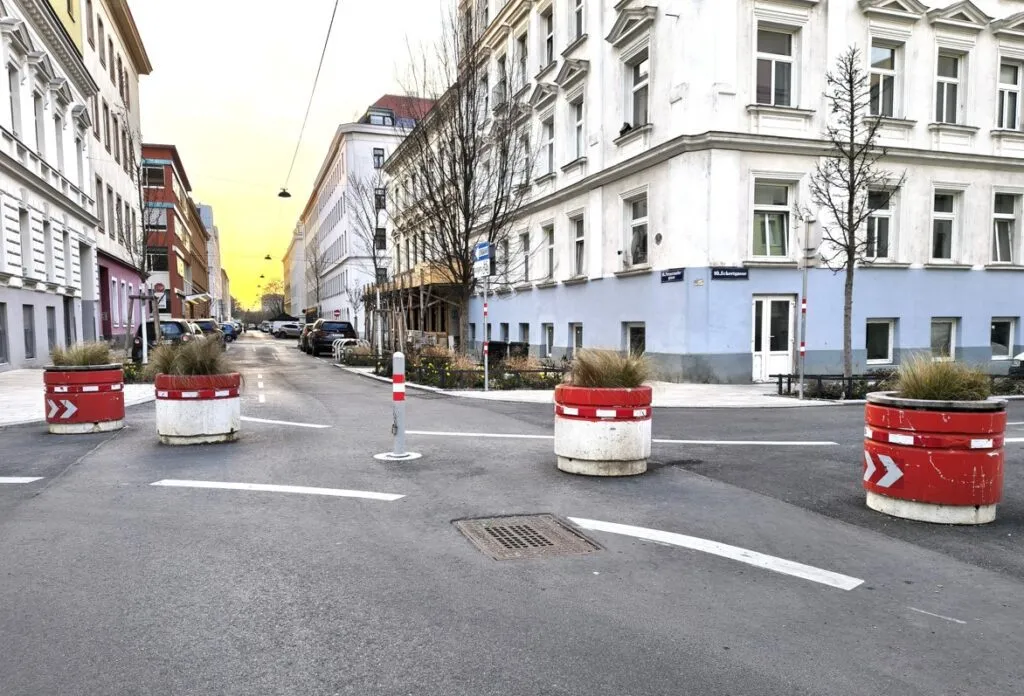
Supergrätzl Favoriten: bollards, upcycled concrete planter rings as traffic filters, and new trees. Photo: Wir machen Wien 2026.
Learning from Berlin
The Kiezblock initiatives from Berlin show that you don’t need perfect plans from the start - in fact, creating a plan together might increase the network of allies. What matters is making a local group visible and keeping it able to act over time.
Do not wait for the finished master plan: a clear area, documented evidence of the problem, and first local allies are enough to start.
Starting your initiative
[To be embedded] Valentina Haas of Changing Cities explains how to start a superblock initiative
Superblock in seven steps
- Define the area: Choose a neighbourhood where you can clearly identify issues with through traffic, routes to school, heat, missing trees or unsafe junctions.
- Document the problem: Record observations, photos, points of conflict and, where possible, traffic counts.
- Form a core team: Clarify roles for research, neighbourhood contact, social media, district contacts and actions.
- State the goal simply: For example, “no through traffic around the school” or “safe routes and more space to spend time inside the neighbourhood”.
- Make a first sketch: Work with a base map and consider where modal filters, one-way streets or places to spend time might fit.
- Build alliances: Talk to residents, parents, schools, local associations, shops and district politicians.
- Make your demand public: Use actions, media work, petitions, district motions or open letters, depending on the political opportunity available.
Playful interventions
Playful interventions show how differently a street could be used. They can be easy to join: chalk, mobile seating, pop-up games, temporary greenery, information stalls, street picnics or visualisations using banners.
The action should do more than look nice: it should make a demand clear. What problem does it show? What solution does it anticipate? Who should act afterwards?
Materials
- Wir machen Wien: How to start superblock initiatives
- Changing Cities: How to Superblock
- Wir machen Wien and Radlobby Wien: Superblocks for Vienna
- Wir machen Wien: Playful interventions
- Radlobby and Geht-doch: Superblock base map