

4. Organising and strategies for change
Organising is more than reach. It is not just about how many people see something, but why they are willing to act together – and what each of them can actually do. Big changes have rarely come from the top down: women’s right to vote, for example, was won by people who organised themselves around a shared cause. The same goes for liveable streets.
If we want things to change, we always have to fight for them from the bottom up.
From one initiative to a movement
Changing Cities shows what this can look like. Since 2019, the Berlin organisation has supported residents in founding neighbourhood initiatives campaigning for . Through workshops, events, and online formats, it shared its knowledge openly. Around 70 initiatives were founded, over 30 Kiezblocks have been politically approved, and 13 are already being implemented on the streets.Figures as presented by Changing Cities at the Toolbox for City Changers workshop, 2026.
Berlin isn’t a Kiezblock paradise yet – but every one of these streets shows what organised neighbours can achieve.
Five tools for organising
Tool 1: Head, heart, hand
Less a tool than a principle to keep in mind whenever you organise people:
- Head: How can we win? Strategy, tactics, arguments.
- Heart: What moves people? A grandchild’s unsafe route to school, a childhood memory of playing in the street, the fear of getting sick from air pollution.
- Hand: What is our lever to win, and how can people take action? Always make a concrete offer – a task, an event, something to join.
A movement from below can only grow when you address all three.
Tool 2: Spectrum of allies
Who are you actually trying to reach? Initiatives often focus too much on their opponents. George Lakey’s spectrum of allies (Training for Change) sorts the people around you into five groups:
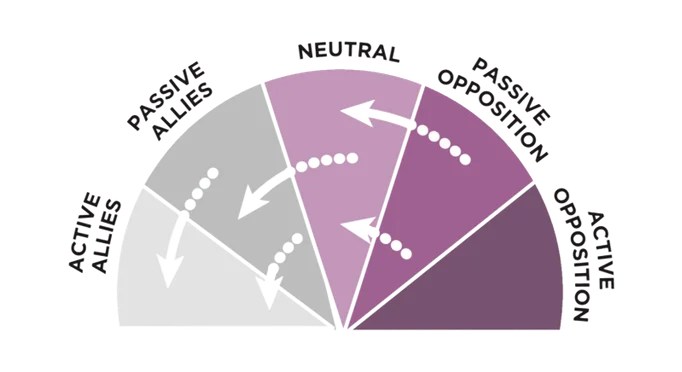
The spectrum of allies by George Lakey, graphic by Beautiful Trouble. Arrows show how people can shift towards greater support.
The aim is not to turn everyone into active allies at once. The key is to move one group one step closer to you. Start on the allies’ side and leave the opposition aside for now.
| Group | What to do |
|---|---|
| Active allies | Build strong relationships – above all through personal encounters such as meetings, events, and workshops. Give them something concrete to do. |
| Passive allies | Find out what keeps them passive, then offer a small, concrete step – like baking a cake for the next (a street temporarily closed so children can play). |
| Neutral | They can shift either way. Introduce yourselves: door-knocking, an info stand in your street, flyers. |
The opposition is often loud, which makes it seem big. But which group is usually the largest?
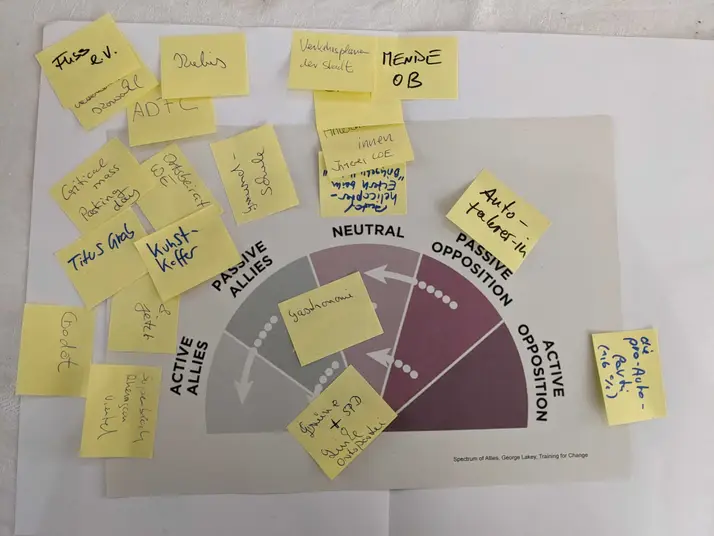
Filling in the spectrum of allies with local stakeholders.
Example: In the founding workshop of a German initiative, the group placed a local school – parents and children – between “passive ally” and “neutral”. They organised an action day in front of the school. People got to know the initiative, and some joined afterwards.
Tool 3: One-on-one conversations
One face-to-face conversation is worth more than five WhatsApp messages.
Conversations stick in people’s minds. They help you find out what moves someone, what makes them angry or hopeful – and win them over to your .
When? At the start of an initiative, to find out which issues really matter in the neighbourhood. Later, invite people to an assembly or ask them to collect signatures, to turn passive allies into active allies.
Where? At the door – or as “street talks” at the bus stop, in front of the supermarket, on the playground.
How? Follow these six steps – with example sentences (select to expand):
1. Introduction
“Hi, my name is … I live nearby, and I’m part of the neighbourhood initiative. Today we’re talking to lots of people in our neighbourhood.”
2. Find out what moves the person
Ask how they feel about the situation – “How do you feel about the traffic in our neighbourhood? What would you like to change?” Then go deeper: “What does that mean for you, your family, and your daily life?”
3. Create urgency
Help them see that the status quo is not a given: “Who do you think is responsible? What’s keeping the problem from being fixed? Don’t you think it’s unfair that cars get so much space and pedestrians so little?”
4. Your plan to win
Only now is it your turn to talk: “You said … Many people we talked to feel the same. That is why we decided to take action.” Explain what your initiative is planning – a demonstration, a petition, talks with local politicians – and make clear: this will only work if we do it together.
5. The ask
A direct question: “Will you join? Can I count on you?”
6. Next step
Always end with a concrete agreement: “See you at the meeting on …?” or “I’ll add you to the group now.”
Tool 4: Contact management
Contact management sounds basic, but it is often underestimated. Collect more than an email address: a phone number, the topics a person cares about (their heart), and any special skills – maybe someone knows how to build a website.
Then use this information: invite people personally to events about the topics they care about, or call them and ask for something specific. A spreadsheet is fine to start with; dedicated organising apps are also emerging.
Tool 5: Sharing responsibility
Only those who carry responsibility for a task are part of the movement.
Stable groups need responsibility to be shared – not carried by a handful of people.
- Ask one-on-one: Ask a room of 20 people who will take on a task: nobody raises a hand. Ask someone directly before or after the meeting, and most people say yes.
- Tandems: Pair a new person with an experienced one – even for small tasks.
- Delegate outwards: There will always be a core group, and that’s fine. But keep handing tasks to less engaged people, such as those in your chat group who rarely come to meetings: distributing flyers, collecting signatures, painting posters.
Lessons from the discussion
- Be approachable: present yourselves as an initiative with a cause, not as a consortium of experts.
- Find shared benefits: a separate bike lane can also make things better for buses and cars.
- Know your facts: when streets are closed, often occurs: overall traffic decreases instead of shifting elsewhere.
- Think creatively: positioning an action as an art project can open new doors.
- Don’t be afraid of talking to strangers.
Your own and strategy
Every plan to win rests on a clear story. A narrative of engagement answers four questions:
- What are we working towards?
- Why is now a good ?
- Who can build power with us?
- What change should our pressure bring about?
Wir machen Wien uses the Platz für Wien campaign as an example: many signatures, strong media coverage, and the 2020 Vienna election were meant to create political pressure for a different transport policy. A local initiative can start smaller, but needs the same clarity.
Expand
are assumptions about how social and political change happens. They help you choose tactics deliberately instead of trying everything at once. Three perspectives are particularly useful for local initiatives: major leaps (significant progress becomes possible when a problem is redefined, new actors emerge, or a window of opportunity opens), grassroots (people build power through collective action), and group formation (shared values, identity, and norms keep a group able to act).
A small group should consistently use two or three suitable levers rather than pursuing ten half-heartedly.
The table below lists practical approaches for different needs. means making an issue publicly visible; it is not the same as making major leaps in progress.
| If you mainly need… | … this fits better | Example |
|---|---|---|
| Attention | Agenda setting | Striking image for the media, petition, visible action |
| To build local power | Grassroots organising | One-on-one conversations, spectrum of allies, sharing roles |
| To stabilise a group | Group formation | Clarify values, rituals, shared language |
Campaign structure
A simple campaign structure is enough to start:
- Goal: What should change, and by when?
- Decision point: Who can approve or prevent it?
- Target groups: Who do we need to activate, persuade, or put under pressure? (Use the spectrum of allies!)
- : Which visible intermediate goals demonstrate progress?
- Tasks: Who handles research, outreach, actions, documentation, media, and political discussions?
- Rhythm: When does the group meet, when does it communicate publicly, and when does it evaluate?
Video
Materials
- Changing Cities: Superblocks – facts (External link (opens in a new tab))
- Wir machen Wien: How to work on strategies for change (External link (opens in a new tab))
- Wir machen Wien: Guide to theories of change (External link (opens in a new tab))
- Evaluation Innovation: Pathways for Change (External link (opens in a new tab))