
2. Starting superblocks
Superblocks reduce through traffic and create space for spending time, walking, cycling, greenery and neighbourhood life. Barcelona made the concept internationally known; Berlin developed Kiezblocks, a version strongly driven by local initiatives; Vienna has a high-quality implementation in Supergrätzl Favoriten and is now discussing cheaper “low-traffic neighbourhoods”.
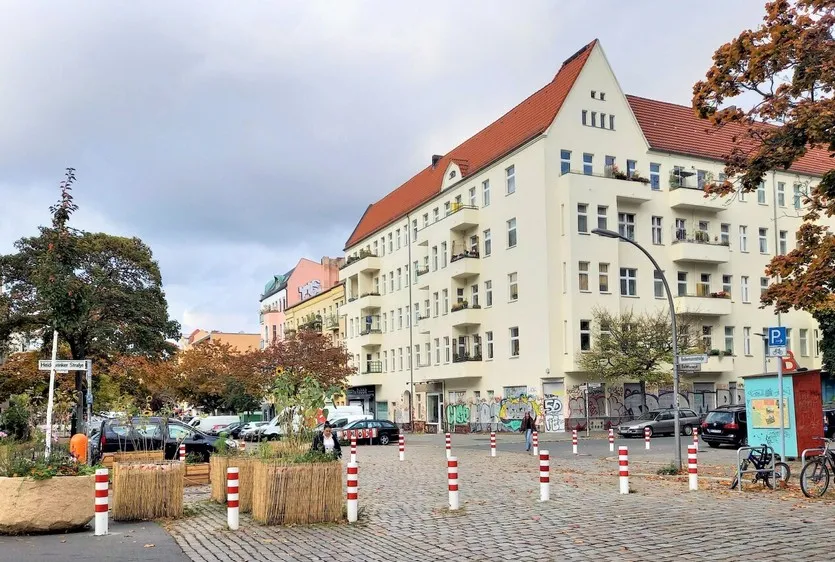
Bellermannkiezblock in Berlin-Mitte. Photo: BA SGA Mitte, L. Fritsche.
What changes
A superblock is more than a single piece of street furniture or a greening project. The central lever is traffic management:
- Modal filters, one-way systems, bollards and other measures prevent through traffic.
- Access and delivery traffic remain possible, but move more slowly and under more direct control.
- Space inside the area becomes available for spending time, routes to school, small open spaces, trees, seating and safe junctions.
| Question | Superblock logic | Single measure |
|---|---|---|
| Traffic | Through traffic is systematically interrupted across the area | One junction, pavement or section is improved |
| Space gained | Several streets become newly usable together | One specific place becomes safer or more pleasant |
| Participation | Neighbourhood, schools, businesses and district need a shared vision | Affected groups can be involved in a targeted way |
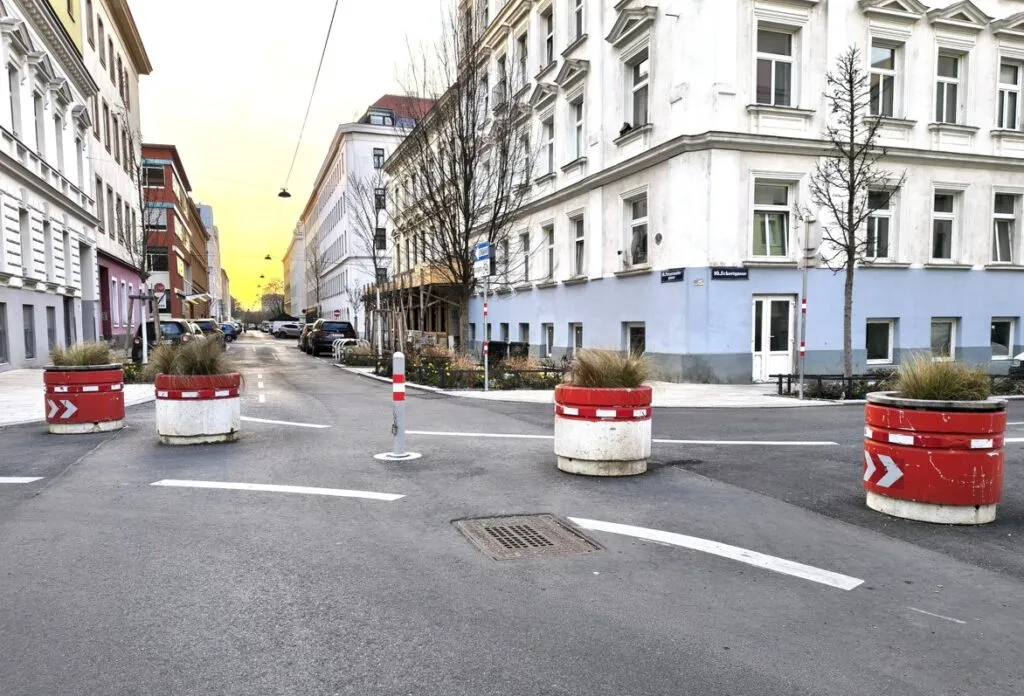
Supergrätzl Favoriten: bollards, upcycled concrete planter rings as traffic filters, and new trees. Photo: Wir machen Wien 2026.
Learning from Berlin
Changing Cities shows that superblock initiatives do not need perfect plans from the start. What matters is making a local group visible and keeping it able to act over time. Berlin’s Kiezblock initiatives work with guides, advice, traffic counts, conversations with businesses, fact checks and ideas for actions.
The lesson for Vienna: do not wait for the finished master plan. Define a clear area, an understandable problem and your first allies.
Do not wait for the finished master plan: a clear area, documented evidence of the problem and first local allies are enough to start.
Getting started in seven steps
- Define the area: Choose a neighbourhood where you can clearly identify through traffic, routes to school, heat, missing trees or unsafe junctions.
- Document the problem: Record observations, photos, points of conflict and, where possible, traffic counts.
- Form a core team: Clarify roles for research, neighbourhood contact, social media, district contacts and actions.
- State the goal simply: For example, “no through traffic around the school” or “safe routes and more space to spend time inside the neighbourhood”.
- Make a first sketch: Work with a base map and consider where modal filters, one-way streets or places to spend time might fit.
- Build alliances: Talk to residents, parents, schools, local associations, shops and district politicians.
- Make your demand public: Use actions, media work, petitions, district motions or open letters, depending on the political opportunity available.
Playful interventions
Playful interventions show how differently a street could be used. They can be easy to join: chalk, mobile seating, pop-up games, temporary greenery, information stalls, street picnics or visualisations using banners.
The action should do more than look nice: it should make a demand clear. What problem does it show? What solution does it anticipate? Who should act afterwards?
Materials
- Wir machen Wien: How to start superblock initiatives
- Changing Cities: How to Superblock
- Wir machen Wien and Radlobby Wien: Superblocks for Vienna
- Wir machen Wien: Playful interventions
- Radlobby and Geht-doch: Superblock base map
Video
The public workshop page refers to recordings of the series, but the researched materials contained no verifiable YouTube link for this workshop. Add the link here once the recording has been published or approved for release internally.