
3. Tactical urbanism and street design
Tactical urbanism means low-cost, temporary interventions in urban space that can test changes, make them visible and accelerate political action. This is relevant in Vienna because the city government is considering tactical urbanism and “low-traffic neighbourhoods” as cheaper forms of traffic calming.
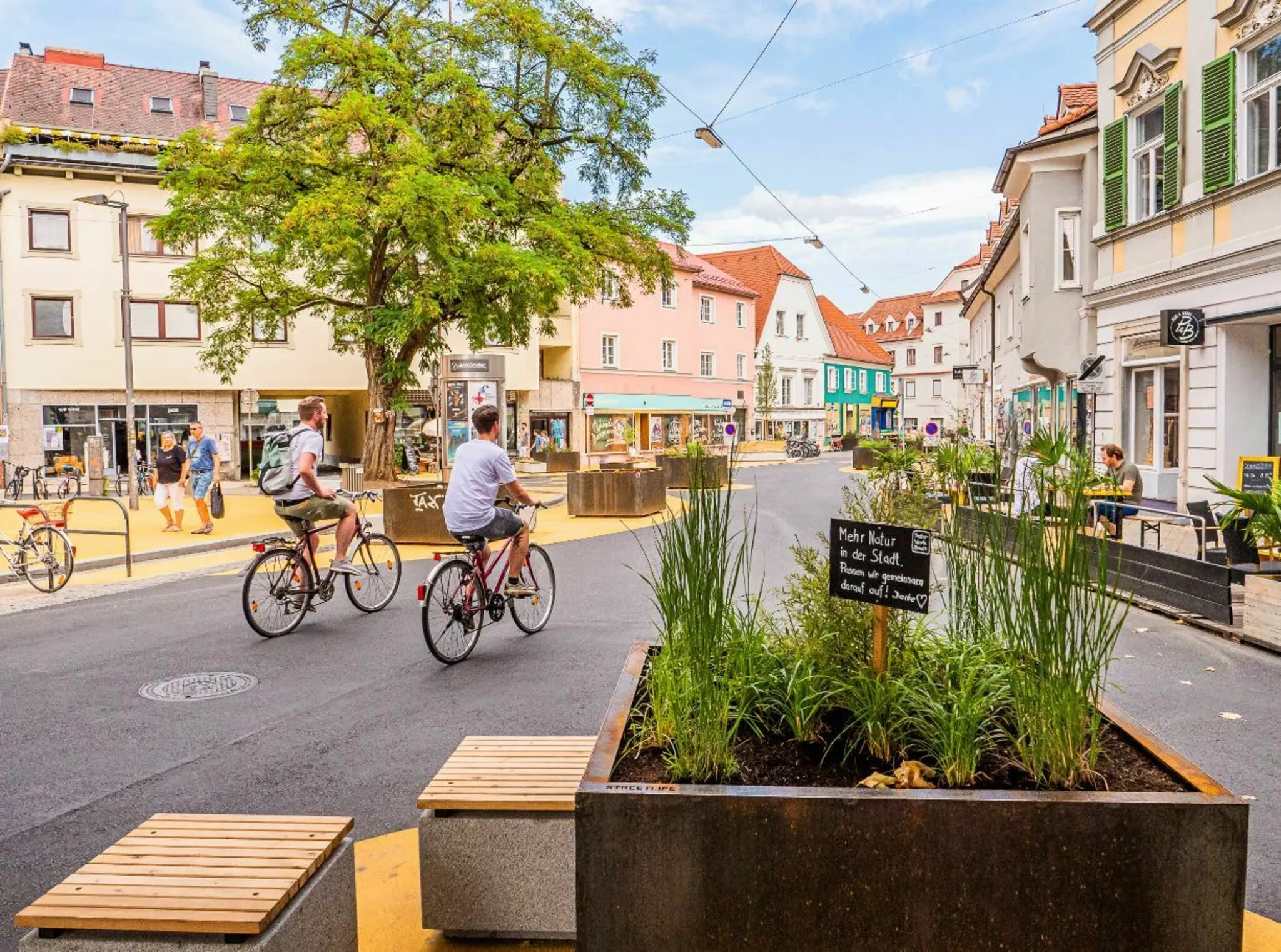
Lendplatz in Graz as an example of traffic-calmed shared spaces with coloured markings. Photo: City of Graz, Simon Gostentschnigg.
Basic principles
Tactical urbanism works particularly well when five conditions come together:
- The measure is rooted locally and solves a specific problem.
- It can be implemented quickly and carries little risk.
- It demonstrates a longer-term change on a small scale.
- It builds relationships between the neighbourhood, initiatives, public administration and politicians.
- It generates useful experience: What works, what needs adjusting, and who uses the space?
Six tools
The Tactical Urbanism Guide and Wir machen Wien materials identify six simple groups of tools:
- Barriers such as bollards, concrete elements or planter rings
- Greenery and planting elements
- Street furniture
- Surface design using colour
- Signs and signage
- Events
Quality lies in the appropriate use of an object, rather than the object itself: a painted surface is only effective if it changes behaviour, helps people find their way or makes a new use plausible.
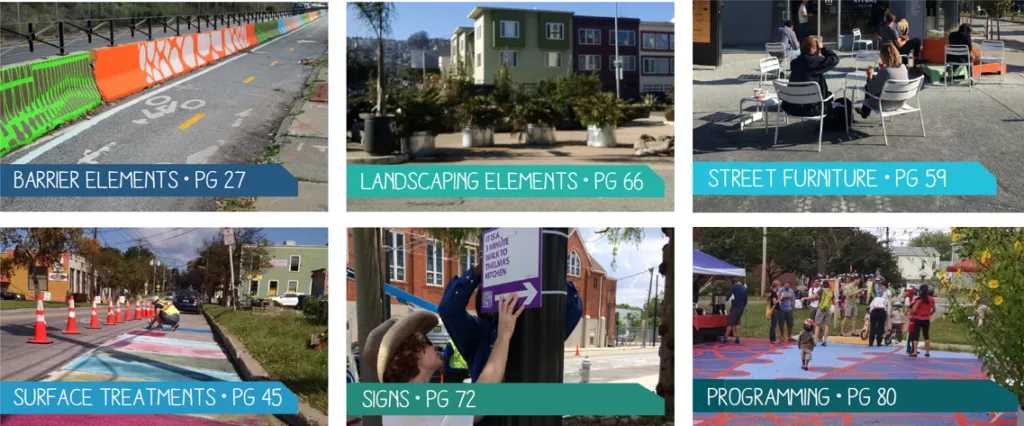
Tool groups from the Tactical Urbanism Guide by Street Plans. Source: Street Plans.
The reality in Vienna
Vienna is highly regulated. Proposed uses of public space need review and approval, particularly by the relevant municipal departments such as MA 46, responsible for traffic management and technical traffic matters.Responsibilities may differ depending on the measure. Early coordination with the district and administration prevents a good idea from failing on formal questions. Bottom-up interventions therefore need an appropriate permit, cooperation with the district or city, or a form of action planned in accordance with the law.
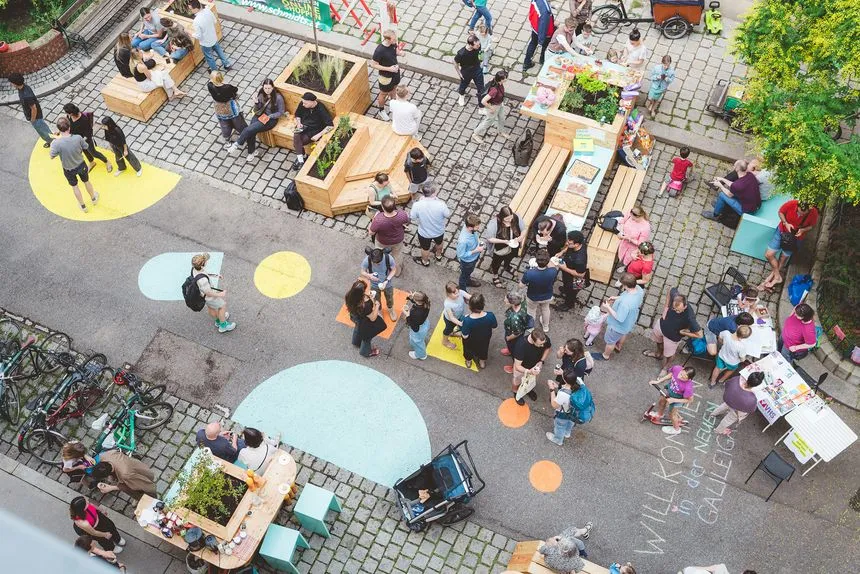
TikTak Galilei in Galileigasse, Vienna. Photo: Tim Dornaus.
Street design as a group tool
Wir machen Wien uses street design workshops to turn dissatisfaction into concrete visions of space. The modules can be used individually or together:
- Street Design Table: A street plan is adapted using paper, scissors and pens. The group discusses uses, space requirements and alternatives.
- Street Banner: Street widths are visibly divided to show how much space could be available for walking, cycling, greenery or spending time.
- Tree Love Set: Mobile tree visualisations show where shade and greenery are needed.
- Leiwander Straßen Radar: A simple survey sheet makes quality of life, safety and the need for action visible.
- Street Shit Bingo: A walk sharpens awareness of obstacles, hazards and absurd misallocations of street space.
Running a local workshop
- Choose a street or junction.
- Gather problems: heat, noise, pavement width, crossings, parking pressure, conflicts, missing seating or green spaces.
- Measure the space or understand its dimensions using plans.
- Build alternatives: minimal, bold, long-term.
- Define an immediate measure: Which temporary action best demonstrates the idea?
- Clarify permits and alliances.
- Document the action afterwards: photos, people’s views, uses, media coverage and political reactions.
Video
Materials
- Wir machen Wien: How to use tactical urbanism in Vienna
- Wir machen Wien: The street design workshop
- Wir machen Wien: Tactical urbanism presentation
- Remake Streets Wien: How coloured markings can change behaviour
- Wir machen Wien: Street design workshops
- Street Plans: Tactical Urbanism Guide