
5. Monitoring: making impact visible
Monitoring means documenting progress and impact so that an initiative can learn, communicate and make political arguments. It does not need to be complicated. What matters is deciding what to observe before an action.
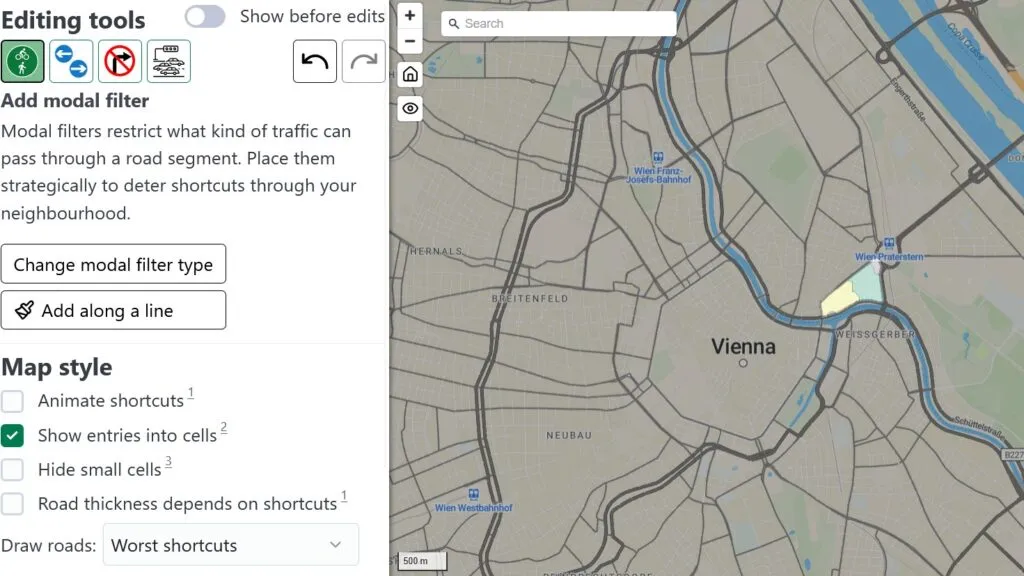
The LTN tool helps test traffic filters and diversions in a neighbourhood scenario. Source: A/B Street LTN Tool.
What can be measured
Simple indicators work well for superblocks, tactical urbanism and street design:
- Traffic volumes: How many cars, bicycles and pedestrians use a section?
- Speed and conflicts: Where do people drive too fast, and where do dangerous situations arise?
- Use for spending time: Do people stop or sit down, do children play, do conversations emerge?
- Climate and comfort: Is there shade, urban heat, greenery, drinking water or noise reduction?
- Support: How many people sign, attend meetings, share content or offer help?
- Political progress: What motions, discussions, commitments or administrative reviews are taking place?
| Indicator | Simple method | Good result format |
|---|---|---|
| Through traffic | Count at two fixed time windows | Figure, photo, map |
| Quality of stay | On-site observation | Short notes and quotes |
| Heat and comfort | Shade map, photo points, temperature comparison | Before-and-after photo pair |
| Support | Conversations, signatures, meetings | List with roles and contacts |
A minimal monitoring plan
- Document the baseline: photos, a map, a short problem note and an initial count.
- Define a target: for example, less through traffic, more safe crossings or more supporters.
- Choose a method: traffic count, walk, interview, street radar, before-and-after photos or media monitoring.
- Assign responsibilities: one person coordinates data, one photos, and one quotes and contacts.
- Present results: One page is often enough: problem, method, key figures, photos and demand.
- Learn: What needs adjusting in your demand, action or alliance-building?
Monitoring as mobilisation
Monitoring can itself be an action. A street traffic count gets people talking. A walk with neighbours makes problems visible together. A map of dangerous spots can attract new supporters.
Tools from the series
- Traffic counts following the Changing Cities approach
- Conversation guides for businesses and local actors
- Leiwander Straßen Radar for quick on-site assessment
- Superblock base map and LTN tool for spatial scenarios
- Before-and-after documentation for tactical urbanism actions
Video
The workshop announcement lists mobilisation and monitoring tools for the third session. No verifiable video link was visible in the publicly researchable materials. Add the link here once the recording has been published or approved for release internally.